When a Nutrient Deficiency Is Really a Season Change: Reading Pale Growth Without Reaching for the Bottle
Share
Every late winter, the same scene plays out on windowsills and in greenhouses: a plant that looked robust in autumn starts pushing pale, yellowish new growth. The instinctive response is to conclude the plant is hungry, buy a bottle, and feed it. Sometimes that is right. Often it is not, and the difference matters because unnecessary feeding can create the very root-zone problems that make nutrients unavailable in the first place.
The central distinction is this: a true nutrient deficiency means a nutrient is genuinely scarce relative to what the plant needs. A nutrient uptake problem means the nutrient may be present in the growing medium, but roots cannot access it because of pH, moisture, oxygen, temperature, damaged roots, or salt accumulation. And a third possibility, the one most often missed, is that nothing is wrong with nutrition at all—the plant is simply responding to a seasonal shift in light, temperature, or growth rate. Pale new growth during a seasonal transition is a common and frequently benign observation. Treating it as a deficiency before checking the other two categories is guessing with a credit card.
Why New Growth Looks Different From Old Growth
Leaves expand with a burst of cell division and elongation, and the pigment systems that give them their green color develop alongside. Young leaves often emerge lighter than mature leaves because chlorophyll and associated proteins are still accumulating. Many species also produce new growth with a brief reddish or bronzed flush, especially under strong light or cool temperatures. These are normal developmental patterns, not evidence of starvation.
What separates normal pale new growth from a problem is pattern, progression, and context. Normal young leaves green up within a reasonable period and, importantly, the plant continues to produce sturdy stems and adequately sized leaves. A nutrient problem typically shows a more persistent pattern: interveinal yellowing that does not resolve, marginal chlorosis, distortion, or a clear gradient between old and new leaves that matches how mobile a given nutrient is within the plant. Nitrogen, for example, is mobile—plants can move it from older leaves to support new growth, so deficiency often appears first on older foliage. Iron and other relatively immobile nutrients tend to show up on young leaves first. These are general tendencies, not a diagnostic fingerprint you can read from a single leaf.
Seasonal Slowdown Is Not the Same as Starvation
Many plants respond to shortening days and cooler temperatures by reducing growth, and some enter genuine dormancy. A houseplant near a window that receives less light in winter may hold steady or push only sparse, pale growth because photosynthesis is running at a lower rate. The plant is not failing; it is operating under reduced resources. Feeding it heavily in that state does not create more light or warmer roots. It mostly adds soluble salts to a root zone where demand is low.
This is where the seasonal reasoning becomes practical. Before concluding a plant needs fertilizer, ask what changed. Did the light change? Did the plant move? Did temperatures drop? Did watering frequency stay the same while the plant's water use fell? Reduced growth with reduced demand is a coherent seasonal response. Reduced growth with unchanged or increasing inputs is a setup for root-zone trouble.
Where Fertilizer Fits—and Where It Doesn't
Fertilizers supply mineral nutrients, not metabolic energy. Photosynthesis makes the carbohydrates a plant runs on; nutrients are the tools and building blocks that support those processes, but adding them cannot substitute for insufficient light or a compromised root system. If roots are oxygen-starved or damaged, more fertilizer does not help them absorb more—it can add salt stress on top of an already struggling root zone.
This is why diagnosis before intervention matters. A plant showing pale leaves in wet, compacted, or cold soil is a poor candidate for feeding. A plant showing genuine deficiency symptoms in a well-drained medium, under adequate light, with healthy roots and a history of limited nutrient inputs, is a much more plausible candidate. The same visible symptom can point in opposite directions depending on the root zone underneath it.
Reading the Root Zone Before the Label
Roots need a balance of moisture, oxygen, nutrients, and suitable temperature. When that balance slips, uptake efficiency drops even if the medium contains adequate nutrients. Saturated media limit oxygen availability, which impairs root function. Cold root zones slow metabolism and water uptake. Compaction reduces pore space and gas exchange. High salt accumulation from repeated feeding impairs water uptake. Any of these can produce pale, weak growth that superficially resembles deficiency.
Practical observation beats speculation here. Check the moisture at root depth rather than at the surface. Look at the roots if the plant can be lifted without damage. Note whether the medium has broken down and lost structure, whether it drains freely, and whether there is a visible crust of salts at the surface. A simple check of moisture and pH can be useful as an approximate observation, though consumer meters vary in reliability and one reading should not drive a major decision on its own.
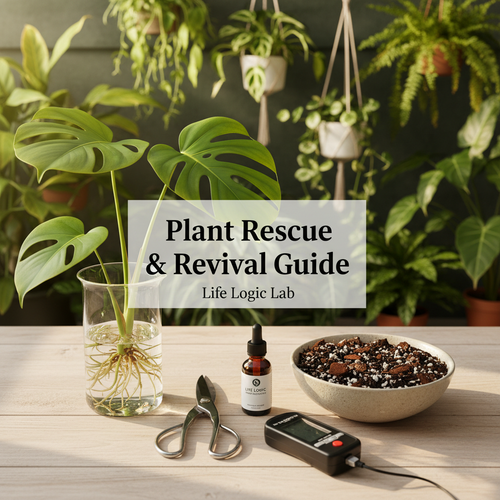
A soil moisture meter is one way to add observations to your judgment, particularly in containers where surface dryness can mislead. Treat its readings as one data point among several, not as a verdict.
A Calm Sequence for Deciding What to Do
When pale growth appears, slow down and work through cause and effect rather than reaching for a product. The order below is a reasoning sequence, not a rigid protocol.
- Check the season and the light. Confirm whether the plant's environment has genuinely changed. Reduced light and cooler temperatures commonly reduce growth and can change leaf color at the margins.
- Assess the root zone. Examine moisture, drainage, compaction, and root health. Yellowing with a persistently wet root zone points toward oxygen and uptake problems, not scarcity.
- Review recent inputs. Note any recent feeding, repotting, or change in water source. A plant that has just received a heavy feed is not the first suspect for deficiency.
- Look at pattern and progression. Distinguish where symptoms appear, whether they spread, and whether new growth matures normally. A single pale leaf is evidence; a consistent, progressing pattern is stronger evidence.
- Change one variable at a time. If you decide to act, act on the most plausible cause and observe the response before adding another intervention.
Only when the season is appropriate, the root zone is sound, and the plant is actively growing should feeding be the leading response. Even then, moderation matters. A modest, appropriate fertilizer based on the plant's actual growth stage is more sensible than a heavy dose justified by a pale leaf.
If you do decide that nutrition is the missing piece, a gentle, organic-leaning amendment can be part of a considered approach rather than a reflex. Something like worm castings fertilizer contributes organic matter and nutrients in a form that behaves differently from concentrated soluble feeds; it is not a cure for a root-zone problem and should not be applied to a plant whose real issue is waterlogged or cold roots. For those who prefer a liquid supplement alongside a general feeding routine, a plant vitamin supplement is a category of product to research carefully—these vary widely in composition, and no supplement compensates for inadequate light or oxygen.
Why "More" Is a Poor Strategy
The temptation, once a plant looks pale, is to feed more and feed often. This is exactly the pattern that leads to salt accumulation in containers, especially where drainage is imperfect and watering does not flush the root zone effectively. Salts from fertilizers and irrigation water can build up over time and impair water uptake, producing the same wilted or discolored look that triggered the feeding in the first place. A mildly overfed plant can look worse than an underfed one, and the correction is not another bottle.
Similarly, diagnosing a specific micronutrient deficiency from a single symptom is unreliable. Multiple micronutrient deficiencies share visual overlap with pH-induced unavailability, root damage, disease, and simple aging. Without soil or tissue testing, the honest position is that you have a suspected nutrient problem, not a confirmed one.
Ending the Guesswork
The most useful habit here is to treat pale growth as a question rather than an answer. Ask what the plant is actually doing this season, whether its roots have the conditions to take up nutrients at all, and whether the symptom is progressing in a way that matches scarcity. Seasonal slowdown and genuine deficiency can look alike at a glance, but they call for very different responses. One calls for patience and adjusted expectations; the other may justify feeding. Confusing them wastes money, adds unnecessary salts to the root zone, and can turn a benign seasonal phase into a real problem. A plant that greens up on its own schedule is often telling you it was never hungry—just waiting for more light.